

[Mar 27, 2026] Lesson Brilliant PDF for the Salesforce-MuleSoft-Developer-I Tests Free Updated Today
Get New 2026 Valid Practice Salesforce MuleSoft Salesforce-MuleSoft-Developer-I Q&A - Testing Engine
Salesforce Salesforce-MuleSoft-Developer-I Exam Syllabus Topics:
| Topic | Details |
|---|---|
| Topic 1 |
|
| Topic 2 |
|
| Topic 3 |
|
| Topic 4 |
|
| Topic 5 |
|
| Topic 6 |
|
| Topic 7 |
|
NEW QUESTION # 16
What is the minimum Cloudhub worker size that can be specified while deploying muleapplication?
- A. 0.1 vCores
- B. 1.0 vCores
- C. 0.5 vCores
- D. 0.2 vCores
Answer: A
Explanation:
Correct answer is 0.1 vCores
MuleSoft Doc Ref :https://docs.mulesoft.com/runtime-manager/cloudhub-architecture#cloudhub-workers CloudHub Workers Workers are dedicated instances of Mule runtime engine that run your integration applications on CloudHub.
The memory capacity and processing power of a worker depends on how you configure it at the application level.
Worker sizes have different compute, memory, and storage capacities. You can scale workers vertically by selecting one of the available worker sizes:
Table Description automatically generated
NEW QUESTION # 17
The new RAML spec has been published to Anypoint Exchange with client credentials.
What is the next step to gain access to the API?
- A. Email the owners of the API
- B. Create a new client application
- C. Request access to the API in Anypoint Exchange
- D. No additional steps needed
Answer: C
Explanation:
Correct answer is Request access to the API in Anypoint Exchange. This way we can get clientId and Client secret which we can use to access the API
NEW QUESTION # 18
Refer to the exhibits. The Mule application does NOT define any global error handler elements. A web client sends a GET request to the HTTP Listener. What responsemessage is returned to the web client?
- A. "Start"
- B. "Siring is not blank"
- C. "End"
- D. -...
Answer: B
NEW QUESTION # 19
What is the correct syntax to define and call a function in Database?
- A.

- B.

- C.

- D.

Answer: B
Explanation:
Keyword to ad function in Dataweave transformation is fun. Hence option 2 and 4 are invalid. Also parameters needs to be passed exactly in same order as defined in function definition. Hence correct answer is' fun addKV( object: Object, key: String, value: Any) = object ++ {(key):(value)}
---
addKV ( {"hello': "world"}, "hola", "mundo" )
MuleSoft Documentation Reference : https://docs.mulesoft.com/mule-runtime/4.3/dataweave-functions DataWeave Function Definition Syntax To define a function in DataWeave use the following syntax:
fun myFunction(param1, param2, ...) = <code to execute>
The fun keyword starts the definition of a function.
myFunction is the name you define for the function.
Function names must be valid identifiers.
(param1, param2, ... , paramn) represents the parameters that your function accepts.
You can specify from zero to any number of parameters, separated by commas (,) and enclosed in parentheses.
The = sign marks the beginning of the code block to execute when the function is called.
<code to execute> represents the actual code that you define for your function.
NEW QUESTION # 20
Refer to the exhibits.
A Mule application has an HTTP Request that is configured with hardcoded values. To change this, the Mule application is configured to use a properties file named config.yaml.
what valid expression can the HTTP Request host value be set to so that it is no longer hardcoded?
- A. ${training.host}
- B. ${training:host}
- C. #[training:host]
- D. #[training.host]
Answer: A
Explanation:
Correct answer is ${training.host}
-------------------------------------------------------------------------------------------------------------------------------------------------- How to Configure Properties to Mule 4.X Platform?
1) Go to /src/main/resources project directory.
2) Create a configuration file with the name configuration.yaml inside the newly created config folder.
3) Go To Project > Global Element > Create > General >select the configuration.yaml file create in step- 2)
4) To verify develop a simple flow with HTTP listener which has above entries. Put the logger that prints the values on console.
5) Additional info: Similarly, when you want to access this port in DataWeave you need to use p function
NEW QUESTION # 21
What happens to the attributes of a Mule event in a flow after an outbound HTTP Request is made?
- A. New attributes may be added from the HTTP response headers, but no headers are ever removed
- B. Attributes arereplaced with new attributes from the HTTP Request response (which might be null)
- C. Previous attributes are passed unchanged
- D. Attributes do not change
Answer: B
Explanation:
Attributes are replaced with new attributes from the HTTP Request response.
Attributes include everything apart from Payload/body. For ex: Headers, query parameters, URI parameters.
So, when outbound HTTP request is made, new attributes need to passthe outbound HTTP request and old attributes are replaced.
I have created below diagram to make it easy for you to understand:
Diagram Description automatically generated
NEW QUESTION # 22
Refer to the exhibits.

Mule application has an HTTP request configuration where host name is hardcoded. Organization is looking to move host and port values to configuration file. What valid expression can be used to so that HTTP configuration can pick the value from configuration file?
- A. #{training.host}
- B. ${training.host}
- C. #[training.host]
- D. ${http.host}
Answer: B
Explanation:
Correct answer is ${training.host}
NEW QUESTION # 23
Correct answer is {customerID}.
- A. fun toUpper(userName) -> upper(userName)
- B. fun toUpper(userName) = upper(userName)
- C. var toUpper(userName) = upper(userName)
- D. var toUpper(userName) -> upper(userName)
Answer: B
Explanation:
Reference:https://docs.mulesoft.com/http-connector/1.5/http-listener-ref A function named toUpper needs to be defined that accepts a string named userName and returns the string in uppercase.
What is the correct DW code to definethe toUpper function?
NEW QUESTION # 24
A company has an API to manage purchase orders, with each record identified by a unique purchase order ID. The API was built with RAML according to MuleSoft best practices.
What URI should a web client use to request order P05555?
- A. /orders/{P05555}
- B. /orders?order=P05555
- C. /orders/P05555
- D. /orders/order=P05555
Answer: C
NEW QUESTION # 25
What should this endpoint return considering the API is build using standard practices?
http://dev.acme.com/api/patients?year=2021
- A. Patients from year 2021
- B. All patients
- C. Patient with id 2021
- D. No patients
Answer: A
Explanation:
Correct answer is Patients from year 2021.
The thing to note here is that year is not a query parameter and not the uri parameter. Hence it will filter all the patients and return the ones for whom year is 2021
NEW QUESTION # 26
Refer to the exhibit.
What datais expected by the POST /accounts endpoint?
- A.

- B.

- C.

- D.
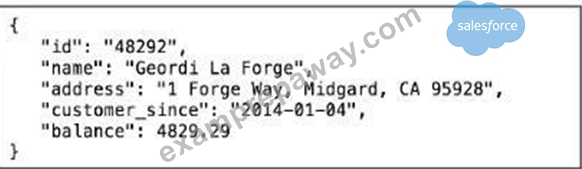
Answer: A
NEW QUESTION # 27
What are the latest specification of RAML available?
- A. 0
- B. 1
- C. 1.2
- D. 0.8
Answer: B
Explanation:
The current version of the RAML specification is 1.0
You can check RAML version in RAML definition by referring to first comment. See highlighted part in below image.
NEW QUESTION # 28
Refer to the exhibits.
A Mule application has an HTTP Request that is configured with hardcoded values. To change this, the Mule application is configured to use a properties file named config.yaml.
what valid expression can the HTTP Request host value be set to so that it is no longer hardcoded?
- A. ${training.host}
- B. ${training:host}
- C. #[training:host]
- D. #[training.host]
Answer: A
Explanation:
Correct answer is ${training.host}
---------------------------------------------------------------------------------------------------------------------------------------- How to Configure Properties to Mule 4.X Platform?
1) Go to /src/main/resources project directory.
2) Create aconfiguration file with the name configuration.yaml inside the newly created config folder.
Graphical user interface, application, Word Description automatically generated
3) Go To Project > Global Element > Create > General >select the configuration.yaml file create in step- 2) Graphical user interface, application Description automatically generated
4) To verify develop a simple flow with HTTP listener which has above entries. Put the logger that prints the values on console.
Graphical user interface, application Description automatically generated
5) Additional info: Similarly, when you want to access this port in DataWeave you need to use p function Graphical user interface, text, application, email Description automatically
generated
NEW QUESTION # 29
Refer to the exhibits.
A web client sends sale data in a POST request to the Mule application. The Transform Message component then enrich the payload by prepending a vendor name to the sale data.
What is written to the sales.csv file when the flow executes?
- A. The enriched payload in CSV format
- B. The enriched payload in XML format
- C. An error message
- D. The enriched payload in JSON format
Answer: D
NEW QUESTION # 30
Refer to the exhibits.
A web client sends a GET request to the HTTP Listener.
What response message is returned to the web client?
- A. "Start"
- B. ""
- C. "String is not blank"
- D. "End"
Answer: D
Explanation:
1. Set Payload "Start"
2. 'Is Balnk String' Creates an Error object with #[error.description] ="String is not blank"
3. Default Error Handler catches and Propagates error
4. 'On Error Propogate' is 'RED IN RED OUT'. It Returns Status Code : 500 & #[error.description]
-------------------------------------------------------------------------------------------------------------------------- Correct answer is String is not blank. Because validation component will throw an error as payload is not blank.
Bottom of Form
Top of Form
NEW QUESTION # 31
What statement is a part of MuleSoft's description of an application network?
- A. Creates reusable APIs and assets designed to be consumed by other business units
- B. Creates and manages a collection of JMS messaging services and infrastructure
- C. Creates and manages high availability and fault tolerant services and infrastructure
- D. Leverages Central IT to deliver complete point-to-point solutions with master data management
Answer: A
Explanation:
Creates reusable APIs and assets designed to be consumed by other business units
NEW QUESTION # 32
Refer to the exhibits.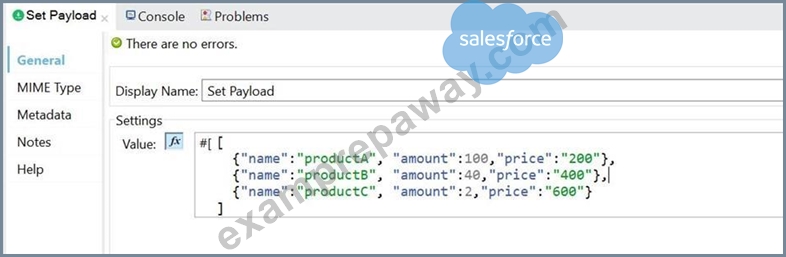


The Batch Job scope contains two Batch Steps scopes with different accept expression.
The input payload is passed to the Batch Job scope.
After the entire payload is processed by the batch job scope , what messages have been logged by the Logger component?
- A. 1.{amount=140}2.{amount=102}3.{step2amount=100}
- B. 1.{amount=140}2.{amount=102}3.{step2amount=100}4.{step2amount=40}
- C. 1.{amount=140}2.{amount=102}3.{step2amount=100}4.{step2amount=140}
- D. 1.{amount=140}2.{amount=102}3.{step2amount=100}4.{step2amount=140}5.{step2amount=102}
Answer: D
Explanation:
This question validates you knowledge on Batch Processing. Before we analyze the question , lets revise a bit about batchfilters.
Batch Filters
You can apply one or more filters as attributes to any number of batch steps.Imagine a batch job whose first batch step checks if a Salesforce contact exists for a record, and a second batch step that updates each existing Salesforce contact with new information. You can apply a filter to the second batch step to ensure it only processes records that didn't fail during the first batch step.By having batch steps accept only some records for processing, you streamline the batch job sothe Mule runtime engine can focus only on the relevant data for a particular batch step.
A batch step uses two attributes to filter records:
acceptExpression
acceptPolicy
Each batch step can accept one acceptExpression and one acceptPolicy attributes to filter records.
Use the acceptExpression attribute to process only records that evaluate to true; if the record evaluates to false, the batch step skips the record and sends it to the next one. In other words, the records with an accept expression that resolves to false are the ones that Mule filters out.
The example below filters out all records where the age is less than 21; the batch step does not process those records.
* <batch:jobjobName="batchJob">
* <batch:process-records>
* <batch:stepname="adultsOnlyStep"acceptExpression="#[payload.age >21]">
* ...
* </batch:step>
* </batch:process-records>
* </batch:job>
Mule Ref Doc : Refining Batch StepsProcessing | MuleSoft Documentation
As we are clear with above concepts , now lets understand this solution step by step.
1) Batch Step (Less than 50)
Accept expression for this batch step is less than 50. Hence elements which will go in this batch step are amount value 40 and 2. Hence output of logger in first batch step is
{amount=140}
{amount=102}
2) Batch Step (Greater than 20)
Accept condition for this batch step is greater than 20. Note that input amount values for this batch step are
100 , 140 and102 (last two values have been updated in batch step less than 50) As all values satisfy this condition out put of second logger is
{step2amount=100}
{step2amount=140}
{step2amount=102}
Hence correct answer to this question is
* {amount=140}
* {amount=102}
* {step2amount=100}
* {step2amount=140}
* {step2amount=102}
2) Batch Step (Greater than 20)
Accept condition for this batch step is greater than 20. Note that input amount values for this batch step are
100 , 140 and 102 (last two values have been updated inbatch step less than 50) As all values satisfy this condition out put of second logger is
{step2amount=100}
{step2amount=140}
{step2amount=102}
Hence correct answer to this question is
{amount=140}
{amount=102}
{step2amount=100}
{step2amount=140}
{step2amount=102}
NEW QUESTION # 33
According to Mulesoft, how are Modern APIs treated as?
- A. Rest API's
- B. Products
- C. SOAP API's
- D. Code
Answer: B
Explanation:
Correct answer is Products
Modern API has three features 1) Treated as products for easy consumption 2) Discoverable and accessible through self-service 3) Easily managed for security , scalability and performance
NEW QUESTION # 34
Refer to the exhibits. Client sends the request to ClientRequestFlow which calls ShippingFlow using HTTP Request activity.
During E2E testing it is found that that HTTP:METHOD_NOT_ALLOWED error is thrown whenever client sends request to this flow.
What attribute you would change in ClientRequestFlow to make this implementation work successfully?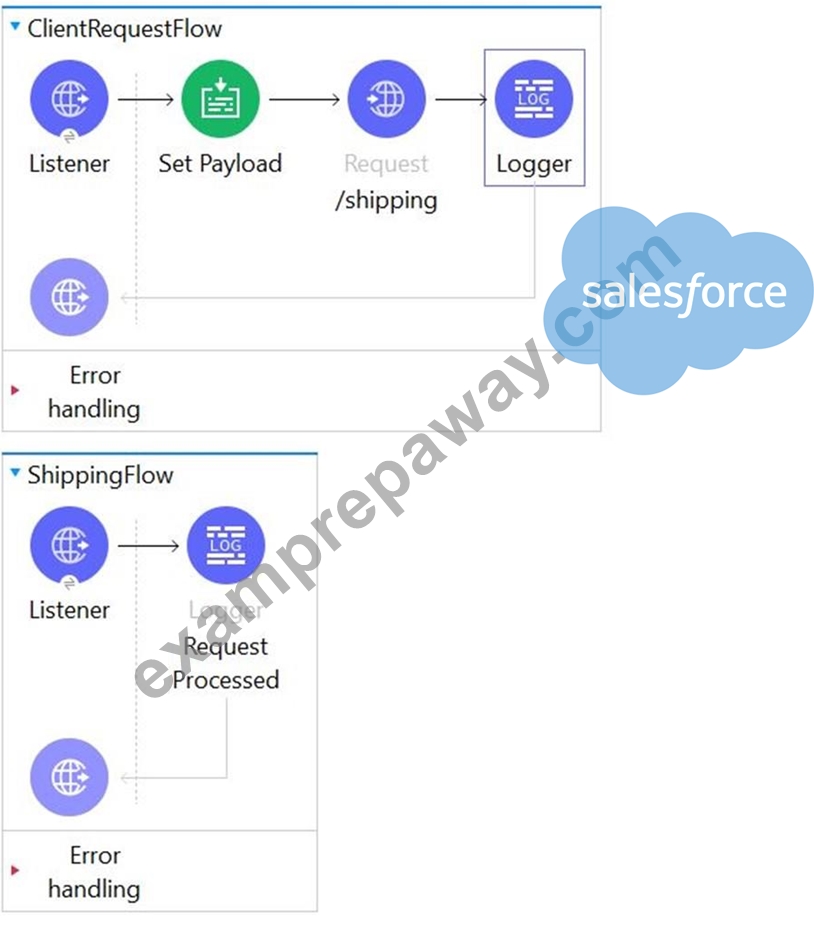


- A. Change the protocol attribute value to "HTTPS"
- B. Change the method attribute value to "*''
- C. Change the allowed method attributes value to "POST"
- D. Change the path attribute value to "/api/ship"
Answer: C
Explanation:
Correct answer is Change the method attributes value to "POST".
It can be fixed in either of the two ways as below.
1) Changing method attribute to POST in ClientRequestFlow
2) Setting allowedMethods as PUT in ShippingFlow (but doesn't fit as question mentions about changing ClientRequestFlow)
NEW QUESTION # 35
What module and operation will throw an error if a Mule events payload is not number ?
- A. Validation modules Is Number operation
- B. Validation modules Is not Number operation
- C. Filter modules Is Number operation
- D. None of these
Answer: A
Explanation:
Correct answer is Validation modules Is Number operation.
Mule 4 does not use filters anymore. The functionality provided by filters in Mule 3 can be achieved by using the Validation Module.
NEW QUESTION # 36
What is the difference between a subflow and a sync flow?
- A. Subflow is synchronous and sync flow is asynchronous
- B. Sync flow has no error handlingof its own and subflow does
- C. No difference
- D. Subflow has no error handling of its own and sync flow does
Answer: D
Explanation:
Correct answer is Subflow has no error handling implementation where as sync flow has.
Subflow
A subflow processes messages synchronously (relative to the flowthat triggered its execution) and always inherits both the processing strategy and exception strategy employed by the triggering flow. While a subflow is running, processing on the triggering flow pauses, then resumes only after the subflow completes its processing and hands the message back to the triggering flow.
Synchronous Flow
A synchronous flow, like a subflow, processes messages synchronously (relative to the flow that triggered its execution). While a synchronous flow is running, processing on the triggering flow pauses, then resumes only after the synchronous flow completes its processing and hands the message back to the triggering flow.
However, unlike a subflow, this type of flow does not inherit processing or exception strategies from the triggering flow.
This type of flow processes messages along a single thread, which is ideally suited to transactional processing
NEW QUESTION # 37
Refer to the exhibits. In the choice router, the When expression for the domestic shipping route is set to "#[payload= "FR"]".
What is the output of logger after the execution of choice router is completed?
- A. "US"
- B. "Domestic"
- C. "International"
- D. A dataweave syntax error
Answer: D
Explanation:
To compare, DataWeave syntax is #[payload == "FR"].
In this case only one = is used so it will give syntax error.
Hence the correct answer is A dataweave syntax error
NEW QUESTION # 38
What is not the function of API Gateway ?
- A. Specify throttling , security and other policies
- B. Determine which traffic is authorized to pass through the API to backend services
- C. Meter the traffic flowing through
- D. Logs all transactions , collecting and tracking analytics data
Answer: A
Explanation:
Correct answer is Specify throttling , security and other policies
MuleSoft Doc Ref : https://docs.mulesoft.com/api-manager/2.x/api-gateway-capabilities-mule4 API Gateway is responsible for below functions.
1) Determine which traffic is authorized
2) Meter the traffic
3) Logs transaction
4) Apply throttling and other policies (Not specifying. These are specified in API Manager)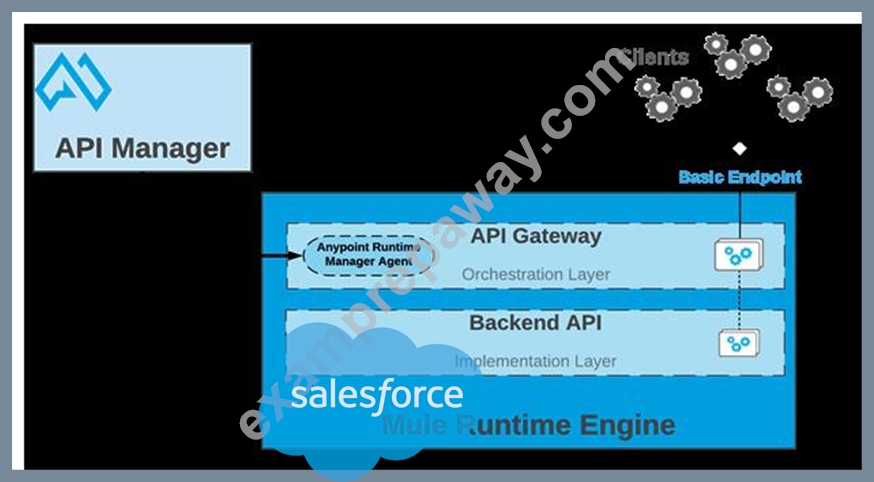
NEW QUESTION # 39
What is not true about application properties?
- A. Application properties provide easier way to manage configurable values
- B. Application properties can be encrypted
- C. Application properties can be defined in .yaml file only
- D. Application properties can be overridden with system properties
Answer: C
Explanation:
Application properties can be defined in .yaml or in .properties file.
MuleSoft Doc Ref : https://docs.mulesoft.com/mule-runtime/4.3/configuring-properties#supported_files
NEW QUESTION # 40
Refer to the exhibits.
The Set Variable transformer is set with value #[ [ first "Max" last"Mule"} ].
What is a valid DataWeave expression to set as the message attribute of the Logger to access the value "Max" from the Mule event?
- A. customer first
- B. vars "customer" "first"
- C. "customer first"
- D. vars "customer first"
Answer: B
NEW QUESTION # 41
......
Salesforce-MuleSoft-Developer-I Dumps PDF - 100% Passing Guarantee: https://skillmeup.examprepaway.com/Salesforce/braindumps.Salesforce-MuleSoft-Developer-I.ete.file.html