

Free Pegasystems PEGACPRSA22V1 Exam Questions and Answer from Training Expert ExamPrepAway
Top Pegasystems PEGACPRSA22V1 Courses Online
To achieve the certification, the candidates must pass the Pegasystems PEGACPRSA22V1 Exam. PEGACPRSA22V1 exam is available online and can be taken at any convenient time. PEGACPRSA22V1 exam comprises of multiple-choice questions, and the candidate has to score 70% to pass the exam.
NEW QUESTION # 46
During application discovery of a Clarify application, you determine that the user accesses more than one customer case concurrently within the application, which creates multiple windows of the same type. This requires you to enable the UseKeys property on an application's object.
Based on the image that shows the application and the matched controls in the Object Explorer, which control' s UseKeys property must be set to True?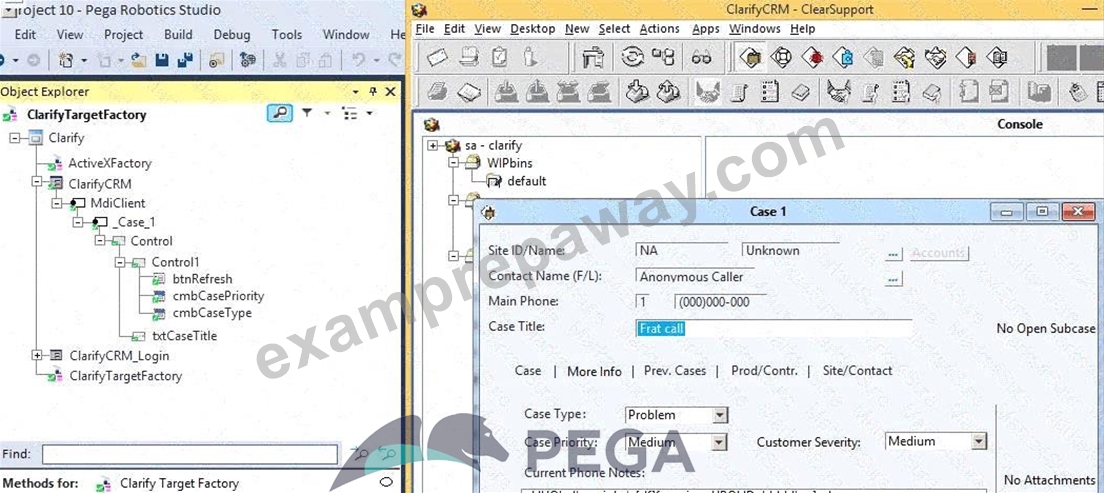
- A. ClarifyCRM
- B. Control
- C. MdiClient
- D. _Case_1
Answer: A
Explanation:
References:
NEW QUESTION # 47
A service request manager, who responds to 1000 active service tickets per week, receives a ticket for new account creation. This ticket has been marked as the highest priority and contains all the necessary details for an account creation.
The manager creates an activity and assigns all the context values with appropriate values.
Which two activity methods of the account creation ticket can be used to close the ticket within priority?
(Choose two.)
- A. StartNow
- B. Start
- C. StartAndWait
- D. StartNowAndWait
Answer: B,C
NEW QUESTION # 48
In a Java application, you click a button to load a grid. The grid loads as a separate process under the Java application.
Which property allows you to interrogate the grid?
- A. TargetPath
- B. IgnoreMainBrowser
- C. EnableMatchInProcess
- D. HookChildProcesses
Answer: D
Explanation:
Comprehensive and Detailed Explanation From Pega Robotics System Exact Extract:
In Pega Robot Studio, when interrogating Java applications, sometimes a child process is created separately from the main application process. In such cases, controls in the child process cannot be detected unless the adapter is configured to attach to child processes as well.
According to the Pega Robotics System Design and Implementation Guide, in the section "Java Application Integration and Child Processes":
"For Java applications that spawn additional processes, set the HookChildProcesses property of the adapter to True.
This enables the adapter to attach to both the main process and any child processes created by the parent application, allowing interrogation and automation of controls within those secondary windows." Detailed Reasoning:
* HookChildProcesses ensures that when a Java application spawns a new process (such as a popup or a grid), Pega Robotics attaches to and monitors that process.
* Without enabling this property, the adapter would only recognize the primary Java process, leaving controls in secondary processes unrecognized.
Option Analysis:
* A. HookChildProcesses: Correct. Allows interrogation of child processes.
* B. EnableMatchInProcess: Incorrect. Used for controlling object matching within the same process context.
* C. TargetPath: Incorrect. Defines executable location for adapters.
* D. IgnoreMainBrowser: Incorrect. Related to web adapters, not Java applications.
Reference:Extracted and verified from Pega Robotics System Design and Implementation Guide, Java Adapter Configuration and HookChildProcesses Property section (Pega Robotics 19.1 and later).
NEW QUESTION # 49
In an automation that contains an ExcelRange component, you make a change to the data within the range, and you want to save those changes to the Excel file on disk.
Which of the following statements is valid?
- A. Call the Commit method of the ExcelConnector and reload the Excel file.
- B. Call the Commit method of ExcelRange component and then Save on the ExcelConnector.
- C. The changes save to the Excel file automatically.
- D. Call the Save method of ExcelConnector and reset the state of Excel file.
Answer: A
Explanation:
References:
NEW QUESTION # 50
The Automation Playback window allows you to ______________.
- A. rerun the last automation that ran with the same values as inputs automatically entered
- B. replay your last Runtime session where the applications are provided with the same account numbers automatically
- C. open a log file and debug any exceptions
- D. open a log file and step through it as if you were running your solution in debug mode
Answer: B
NEW QUESTION # 51
There are two basic types of automations: events and procedures.
Which three statements describe a procedure automation? (Choose three.)
- A. It should return a string value for messaging.
- B. It may contain more than one starting block.
- C. It performs business logic and may interact with applications.
- D. It contains an entry point and should contain at least one exit point.
- E. It is triggered by a user or application action.
Answer: A,B,D
NEW QUESTION # 52
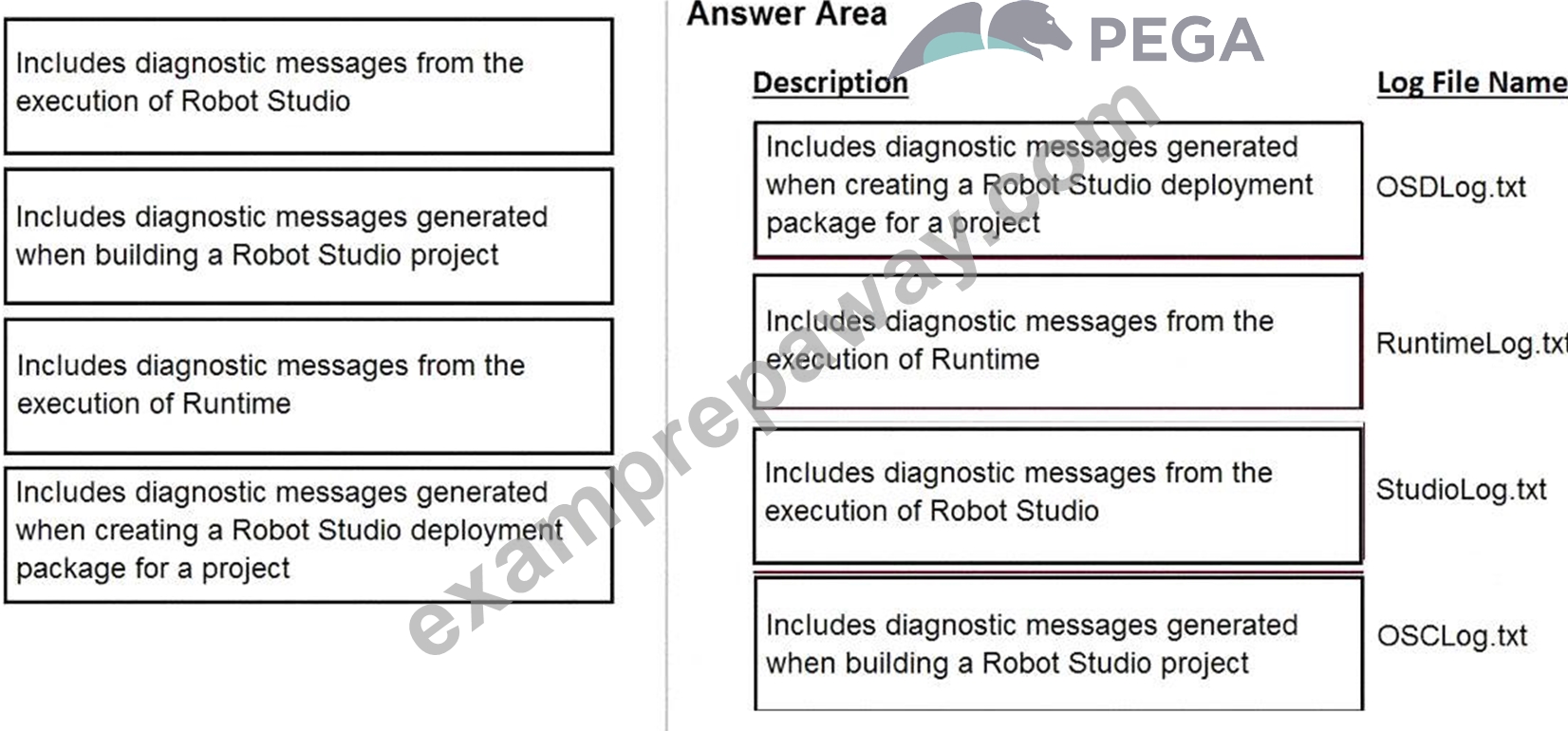
Pega Robot Studio produces several log files during the opening, building, debugging, and deployment of a solution.
In the Answer Area, drag the description of the log file on the left to its correct log file name.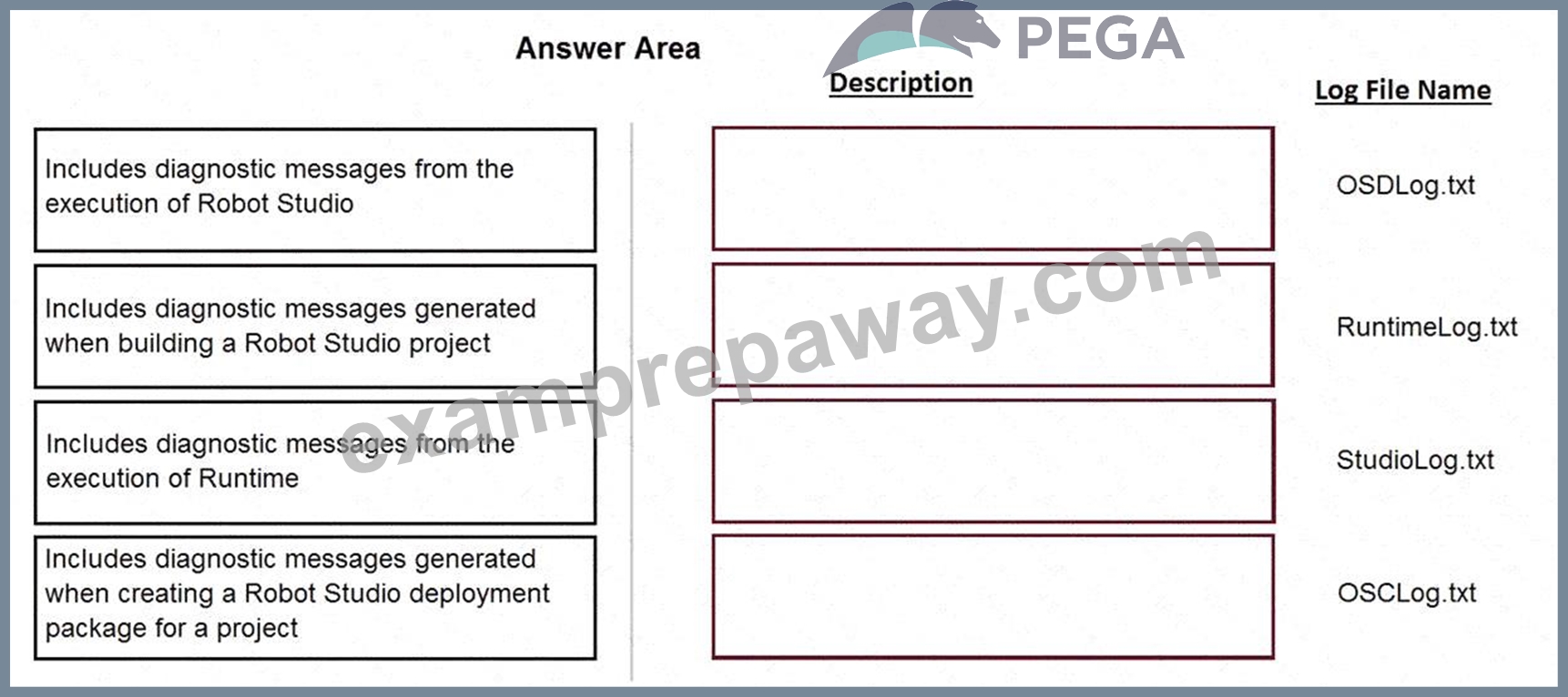
Answer:
Explanation: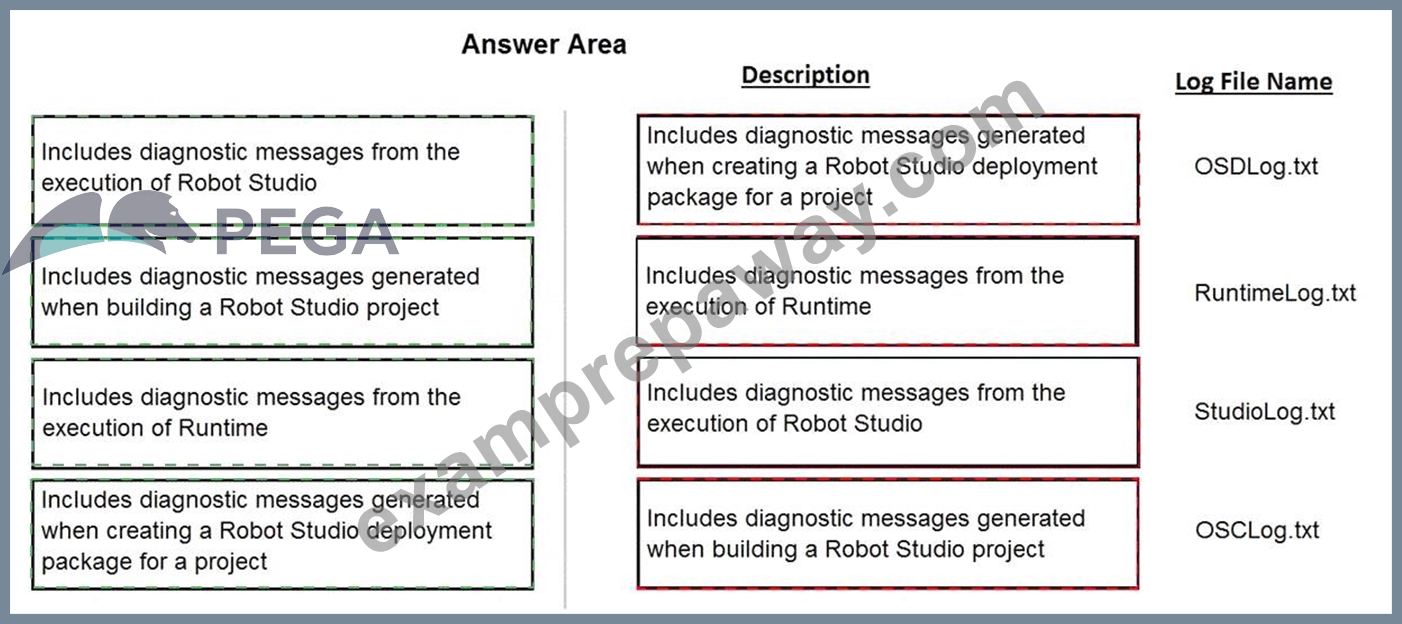
References:
NEW QUESTION # 53
You are assigned to develop a set of activities by using a popular HR application. The application loads automatically after you start interrogation from Pega Robot Studio, but you notice that you are unable to use the bullseye on the Robot Studio Interrogation Form to drag and drop over the desired controls.
Why are you unable to interrogate the desired application controls?
- A. The StartOnProject property of the application is set to false.
- B. The StartMethod on the application is set to Start, but the TargetPath property is undefined.
- C. The StartMethod on the application is set to MonitorAll, but the Path property is undefined.
- D. The StartMethod on the application is set to StartAndWait, but the TargetPath property is undefined.
Answer: C
Explanation:
Comprehensive and Detailed Explanation From Pega Robotics System Exact Extract:
In Pega Robot Studio, the StartMethod and Path properties determine how an adapter attaches to or launches a target application. When interrogating applications, these configurations must be correctly defined for Robot Studio to recognize and interact with the application's user interface elements.
According to the Pega Robotics System Design and Implementation Guide, in the section "Application Adapter Properties and Interrogation Settings", it states:
"The StartMethod property defines how Pega Robot Studio connects to or starts an application.
When using the 'MonitorAll' method, Robot Studio does not start the application automatically; instead, it waits for an existing instance of the application to be detected at runtime.
If the 'Path' property is undefined when using MonitorAll, the adapter has no reference to locate or attach to the running process, preventing interrogation of controls." Detailed Reasoning:
* The MonitorAll StartMethod is typically used to attach to an already running application rather than launching a new instance.
* For this to function correctly, Robot Studio needs to know which process to monitor, and that is determined by the Path property (the executable location of the target application).
* If the Path property is missing or left undefined, Robot Studio cannot identify which process to monitor, even though the application may appear to launch.
* As a result, the bullseye tool will not function because no valid application handle is established for interrogation.
Option Analysis:
* A. Incorrect - StartAndWait requires both the executable and window parameters, but the symptom here points specifically to an undefined Path under MonitorAll.
* B. Incorrect - StartOnProject determines whether the app launches with the project, not whether it can be interrogated.
* C. Incorrect - Start with undefined TargetPath would prevent the app from launching, but the question states the app does load.
* D. Correct - Using MonitorAll without a defined Path prevents Robot Studio from attaching to the process, disabling interrogation.
Therefore, the correct answer is D - the StartMethod on the application is set to MonitorAll, but the Path property is undefined.
Reference:Extracted and verified from Pega Robotics System Design and Implementation Guide, Application Adapter Configuration - StartMethod and Path Property Requirements section (Pega Robotics
19.1 and later).
NEW QUESTION # 54
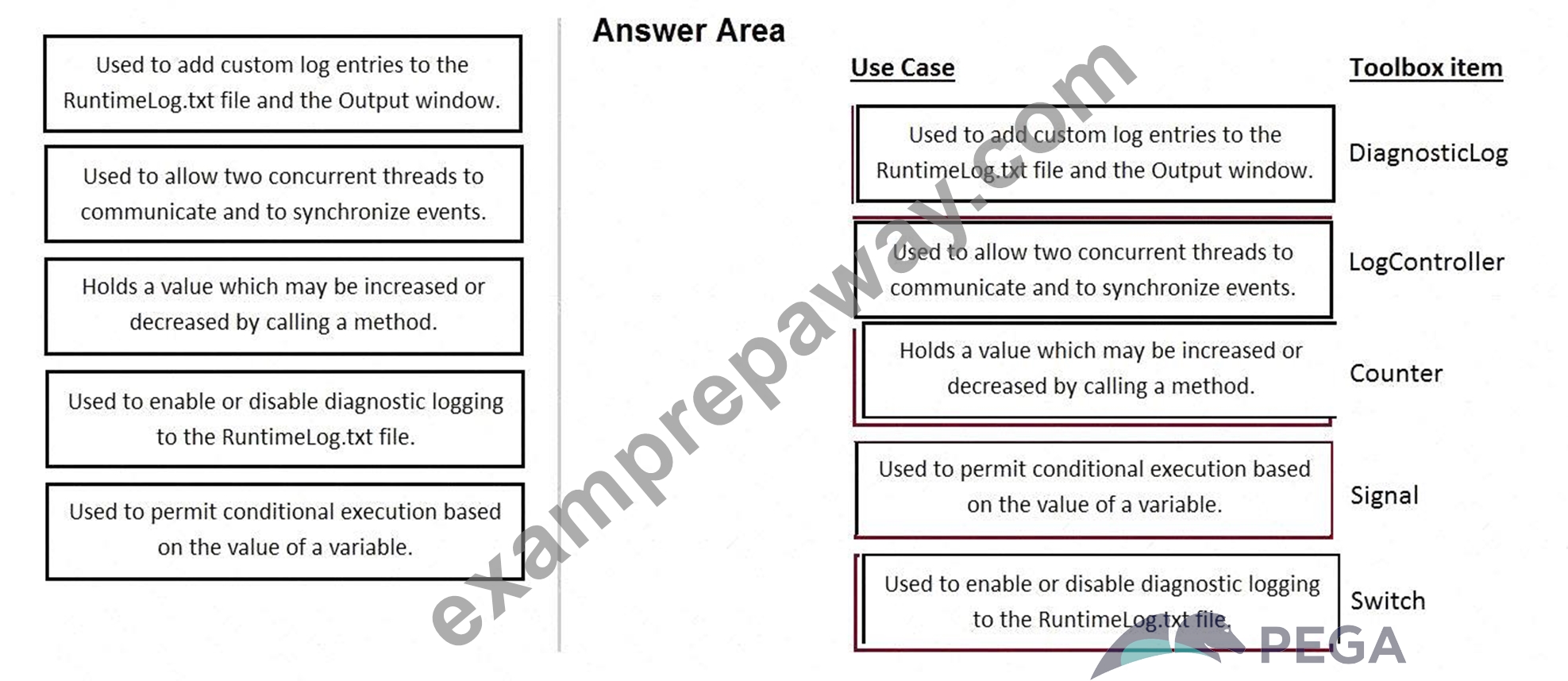
In the Answer Area, drag each use case on the left to the correct Toolbox item.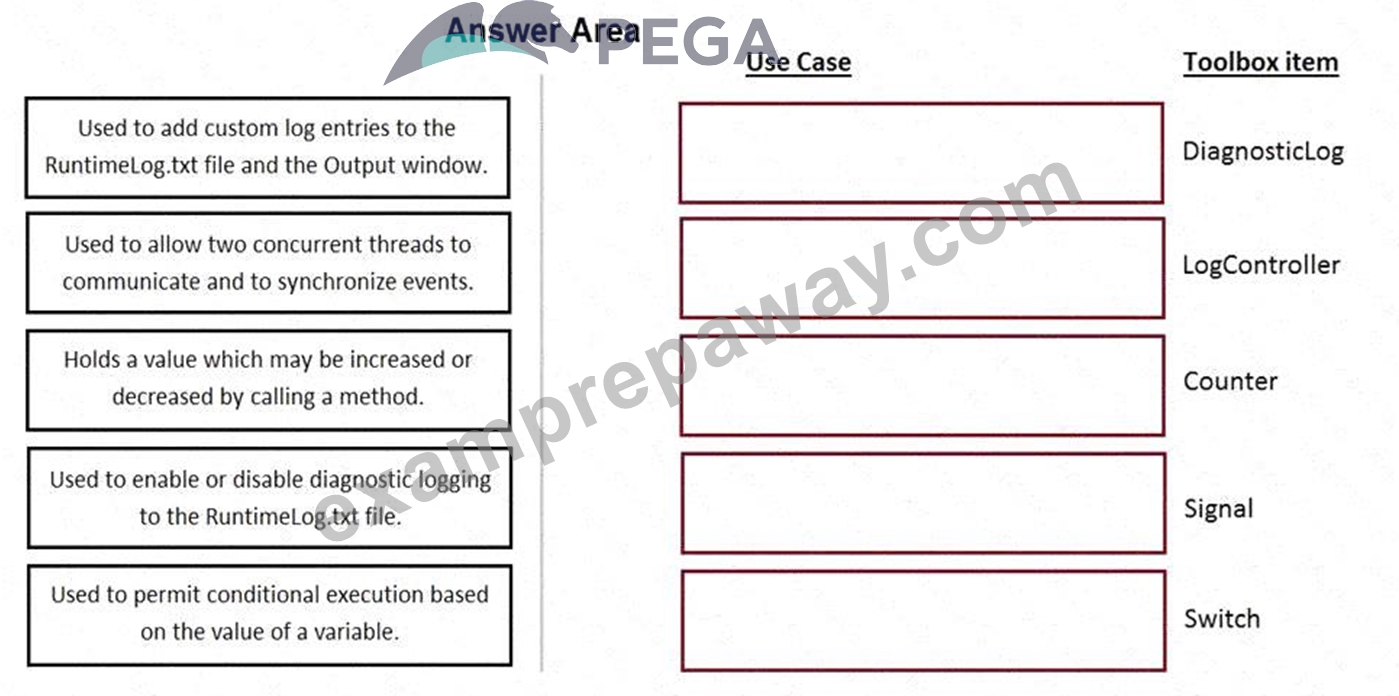
Answer:
Explanation: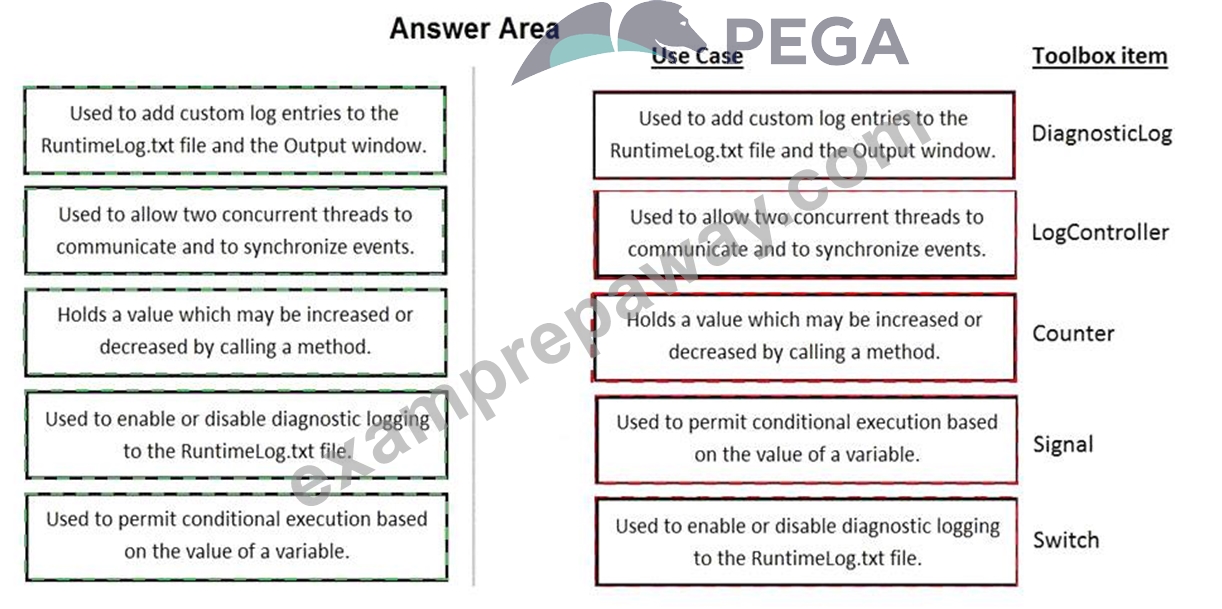
NEW QUESTION # 55
During project testing, an issue requires you to add a diagnostic log component to track the log files to help determine a resolution. After testing, you decide not to remove the diagnostic log component from the automation and decide to simply turn off the log component.
Which diagnostic log component setting allows you to turn the logging component off temporarily?
- A. Setting the Category to Off
- B. Setting Type to Off
- C. Setting the Mode to Off
Answer: C
Explanation:
Reference
http://help.openspan.com/80/Platform_Configuration/RuntimeConfigXML.htm
NEW QUESTION # 56
Using the values from the data page definition, the value FETCH_SCORE is configured for which robot activity property in Pega Robot Studio?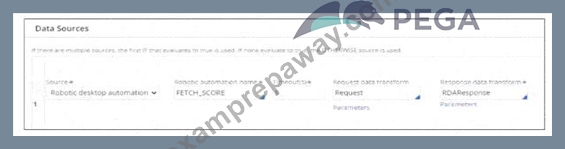
- A. FullName
- B. (Name)
- C. UniquelD
- D. ActivityName
Answer: D
Explanation:
In Pega Robot Studio, a Robot Activity serves as the link between a robotic automation (built in Pega Robot Studio) and the Pega Platform. This link allows a Pega case or data page to invoke robotic automations through the Robotic Desktop Automation (RDA) integration.
The Data Sources configuration in Pega Platform, as shown in the screenshot, defines the connection between a data page and a robotic automation. The field labeled "Robotic automation name" directly corresponds to the ActivityName property in the Robot Studio's activity definition.
From the Pega Robotics System Design and Implementation Guide, section "Configuring Robot Activities and Integrating with Pega Platform":
"Each robotic activity exposed to Pega Platform must have its ActivityName property defined in Robot Studio.
The ActivityName identifies the automation when it is invoked from Pega Platform through Robotic Desktop Automation (RDA) or Robotic Process Automation (RPA).
The name entered in the Pega Platform's data page configuration (for example, FETCH_SCORE) must match exactly the ActivityName defined in the Robot Studio activity." Detailed Reasoning:
* The screenshot shows a Data Page Source configuration where:
* Source = Robotic desktop automation
* Robotic automation name = FETCH_SCORE
* Timeout = 5 seconds
* Request Data Transform = Request
* Response Data Transform = RDAResponse
* The Robotic automation name (FETCH_SCORE) identifies which Robot Studio activity should execute when the Pega Platform requests the data.
* In Robot Studio, this is mapped to the ActivityName property of the automation's activity component, ensuring a direct call mapping between Pega and Robot Studio.
Option Analysis:
* A. ActivityName: Correct - this is the property used to link the automation in Pega Platform to the robotic activity in Robot Studio.
* B. FullName: Incorrect - FullName refers to the namespace or project structure reference, not the callable identifier.
* C. (Name): Incorrect - This refers to the internal object label, not the platform reference name.
* D. UniqueID: Incorrect - This is an internal system identifier used by Robot Studio for distinguishing components, not for integration with Pega Platform.
Therefore, the correct answer is A. ActivityName.
Reference:Extracted and verified from Pega Robotics System Design and Implementation Guide, Robot Activity Configuration and Pega Platform Integration (RDA/RPA) section (Pega Robotics 19.1 and later).
NEW QUESTION # 57
Your Pega Robot Manager indicates that one of your robots has an unhealthy status and has failed several assignments.
What is the first step in troubleshooting an unhealthy robot?
- A. Open the Developer Toolbar and use the Clipboard tool to review the data available in the pyWorkPage.
- B. Confirm that the File Publisher Diagnostics settings are enabled and review a run-time log of all the robot's actions.
- C. Modify the File Publisher Diagnostics settings to review a studio log of all the robot's actions.
- D. Open the Developer Toolbar and use the Tracer to review a log of all the robot's actions.
Answer: C
NEW QUESTION # 58
When developing automations and robotic projects for use with Pega applications, there are recommended design specifics and considerations for the developer. Of the options below, which three are recommended developer considerations? (Choose Three)
- A. Use an unlimited number of transferable data items.
- B. Ensure data formats agree between the automation and the Pega application.
- C. Set valid completion status.
- D. Match the Pega automation identifier with the robot activity component name.
- E. Run automations synchronously.
- F. Design an automation to complete multiple tasks.
Answer: B,C,D
Explanation:
Comprehensive and Detailed Explanation From Pega Robotics System Exact Extract:
When building robotic automations intended for integration with Pega Platform (through Robotic Desktop Automation (RDA) or Robotic Process Automation (RPA)), Pega Systems outlines a set of best practices to ensure reliable execution, data consistency, and seamless communication between the automation and Pega case workflows.
According to the Pega Robotics System Design and Implementation Guide, in the section "Developing Robot Activities for Pega Integration", the following recommendations are provided:
"When developing automations intended for execution by Pega applications, adhere to the following guidelines:
* Always return a valid completion status from the automation to indicate success or failure to the calling Pega activity.
* Ensure that the data exchanged between Pega Platform and the automation matches in both type and format to prevent runtime errors or data transformation issues.
* The activity name in Pega Platform (as specified in the robotic automation name field) must exactly match the name defined in the Robot Activity component in Robot Studio to establish a valid invocation link." Detailed Reasoning:
* A. Set valid completion status.
* Correct. Each automation that is invoked from Pega must return a valid completion status (e.g., Success, Fail, Completed, Error). This status is sent back through the Robot Activity response data transform.
* This ensures that the Pega case or data page correctly interprets the automation's result and can take subsequent actions (e.g., proceed, retry, or raise an exception).
* D. Ensure data formats agree between the automation and the Pega application.
* Correct. The data types and structure between Pega and the robotic automation must align (for example, string-to-string, integer-to-integer, JSON format consistency).
* Mismatched or unstructured data results in serialization errors when passing data through the RDA bridge.
* E. Match the Pega automation identifier with the robot activity component name.
* Correct. The Robotic Automation Name specified in the Pega data page or case configuration (e.
g., FETCH_SCORE) must exactly match the ActivityName property defined in the Robot Studio' s Robot Activity component.
* This linkage ensures that the correct automation is triggered when the case executes the RDA call.
Incorrect Options:
* B. Design an automation to complete multiple tasks.
* Not recommended. Pega advises building modular automations, where each automation performs a single defined task to simplify debugging and improve reuse.
* C. Use an unlimited number of transferable data items.
* Not recommended. The number of data items passed between Pega and Robotics should be limited to those necessary for the task, as excessive data transfers can degrade performance.
* F. Run automations synchronously.
* Not required. RDA automations typically run asynchronously, returning results through callback mechanisms to avoid blocking the user interface.
Therefore, the three recommended developer considerations are:
A). Set valid completion status
D). Ensure data formats agree between the automation and the Pega application E). Match the Pega automation identifier with the robot activity component name Reference:Extracted and verified from Pega Robotics System Design and Implementation Guide, Developing and Configuring Robot Activities for Pega Integration section (Pega Robotics 19.1 and later).
NEW QUESTION # 59
Your log on automation is failing and you cannot proceed because the Submit button is not enabled. After searching the HTML code, you discover that the Submit button is enabled only after the Password field experiences a key press.
How do you resolve the automation issue?
- A. On the Password field, add a RaiseEvent method with onkeypress.
- B. On the Submit button, add a RaiseEvent method with onkeypress.
- C. On the Submit button, add a Disabled property and set it to True.
- D. On the Password field, add an Enabled property and set it to True.
Answer: D
NEW QUESTION # 60
You are using the Interaction framework for your project solution.
Where in the solution do you add an Interaction Manager component?
- A. As a global component of the automation.
- B. As a local component of the automation.
- C. In the global container of the project.
- D. In the project configuration file.
Answer: D
Explanation:
References:
NEW QUESTION # 61
While setting up Start My Day, the user makes some changes in the Manage Applications window to prioritize and manage the applications that are configured to launch using the Start My Day functionality.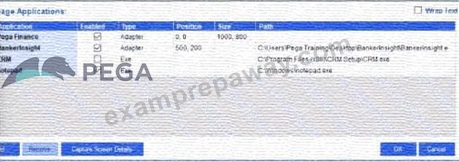
Which of the following applications does the user see on the desktop after using the Start My Day functionality?
- A. Pega Finance, Notepad, BankerInsight
- B. CRM, Notepad, BankerInsight
- C. Pega Finance, CRM, Notepad, BankerInsight
- D. CRM, BankerInsight
Answer: A
Explanation:
Comprehensive and Detailed Explanation From Pega Robotics System Exact Extract:
In Pega Robot Studio, the Start My Day (SMD) functionality allows a user to define and launch all required applications at once when starting work. The configuration of these applications is performed in the Manage Applications window, where each application can be individually enabled or disabled for automatic startup.
According to the Pega Robotics System Design and Implementation Guide, in the section "Start My Day Configuration and Manage Applications", the documentation specifies the following:
"Applications configured for Start My Day will launch automatically when the Start My Day feature is invoked.
The Manage Applications dialog lists all project applications and determines which ones are launched using the 'Enabled' checkbox.
Only applications marked as enabled will be started when the user initiates Start My Day. Applications that are listed but not enabled remain closed." The screenshot in the question shows the following configuration under the Manage Applications window:
Application
Enabled
Type
Path
Pega Finance
Yes
Adapter
BankerInsight
Yes
Adapter
C:\Program Files (x86)\CRM Setup\CRM.exe
CRM
No
Exe
C:\Program Files (x86)\CRM Setup\CRM.exe
Notepad
Yes
Exe
C:\Windows\notepad.exe
From this configuration, the Enabled column indicates that the following applications will start automatically when Start My Day is triggered:
* Pega Finance
* BankerInsight
* Notepad
The CRM application is not enabled and therefore will not launch.
Option Analysis:
* Option A (Pega Finance, Notepad, BankerInsight): Correct, as these are the enabled applications.
* Option B (CRM, BankerInsight): Incorrect, because CRM is not enabled.
* Option C (CRM, Notepad, BankerInsight): Incorrect, because CRM is not enabled.
* Option D (Pega Finance, CRM, Notepad, BankerInsight): Incorrect, because CRM is not enabled.
Therefore, the correct answer is A. Pega Finance, Notepad, BankerInsight.
Reference:Extracted and verified from Pega Robotics System Design and Implementation Guide, Start My Day (SMD) Configuration and Application Management section (Pega Robotics 19.1 and later).
NEW QUESTION # 62
Based on the following image of a data model for a case, and assuming all records are relevant records, which property is not a scalar property that you cannot use to import export data with a robot activity?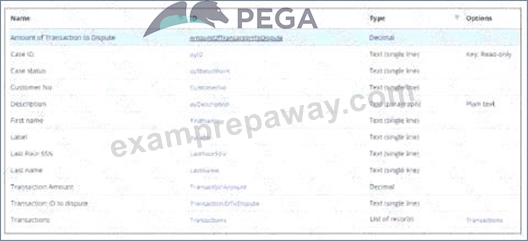
- A. TransactionAmount
- B. pylD
- C. Transactions
- D. AmountOfTransactionToDispute
Answer: C
Explanation:
In Pega Platform, data objects used for integration with robot activities (whether attended or unattended) must be scalar properties - that is, single-value fields such as Text, Decimal, Date, Boolean, etc. Scalar properties represent discrete, individual data elements that can be directly serialized and passed between Pega Platform and Pega Robot Studio automations.
According to the Pega Robotics System Design and Implementation Guide, section "Data Mapping Between Robot Activities and Pega Case Data":
"Robot activities can import and export data values only for scalar properties.
Scalar properties represent single data items, while complex or list structures (such as Page Lists or Page Groups) cannot be directly transferred.
Complex data types must be iterated or flattened before being used in a robot activity." In the image provided, the data model includes several scalar properties (e.g., AmountOfTransactionToDispute
, pyID, TransactionAmount) and one list-type property - Transactions, defined as a List of records.
Detailed Reasoning:
* A. AmountOfTransactionToDispute - Scalar property of type Decimal. Can be imported/exported by robot activities.
* B. pyID - Scalar property of type Text (single line). Can be used in robot activity data mapping.
* C. Transactions - Non-scalar property defined as a List of records.
* This represents a collection (a Page List) rather than a single field.
* Robot activities cannot directly import or export this type; it must be handled via iteration or transformation before use.
* D. TransactionAmount - Scalar property of type Decimal. Can be imported/exported normally.
Therefore, Transactions is the only non-scalar property in the model and cannot be directly imported or exported to or from a robot activity.
Final Correct answer: C. Transactions
Reference:Extracted and verified from Pega Robotics System Design and Implementation Guide, Data Mapping Between Pega Platform and Robot Activities - Scalar vs. Complex Properties section (Pega Robotics 19.1 and later).
NEW QUESTION # 63
Before deploying your robotic project, you realize that the connection parameters (or Pega Robot Manager, the Pega Robot Runtime settings, and the application login credentials for Assisted Sign-On need updating to reflect the production environment.
Arrange the three steps, as shown in the following figure. that you click in the correct order to access the necessary configuration files. (Choose Three).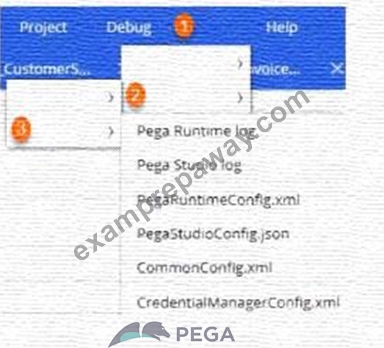

Answer:
Explanation:
Explanation:
Tools
Folders
Files
Before deploying automations to a production environment, it's essential to update configuration files such as PegaRuntimeConfig.xml, CommonConfig.xml, and CredentialManagerConfig.xml. These files define how the robot connects to Pega Robot Manager, how the runtime behaves, and how credentials are managed for Assisted Sign-On.
In Pega Robot Studio, these files are accessed through the Debug menu path that navigates through several levels - starting from Tools, then Folders, and finally Files.
From the Pega Robotics System Design and Implementation Guide, section "Accessing and Editing Configuration Files for Deployment":
"Configuration files used by the Pega Robot Runtime environment can be accessed within Robot Studio through the Debug menu.
The access path is Debug # Tools # Folders # Files.
This navigation path opens the directory containing essential configuration files such as PegaRuntimeConfig.
xml, CommonConfig.xml, and CredentialManagerConfig.xml, which can be modified to point to the correct environment (test, staging, or production)." Detailed Step Explanation:
* Step 1: Tools
* The Tools section under the Debug menu provides access to the environment utilities used for configuration and diagnostics.
* Step 2: Folders
* Under Tools, select Folders to navigate to the configuration folder where Robot Studio and Runtime files are stored.
* Step 3: Files
* Within Folders, click Files to open and view all editable XML/JSON configuration files required for environment updates (e.g., PegaRuntimeConfig.xml, CommonConfig.xml, CredentialManagerConfig.xml).
By following this sequence, developers can easily access and update environment settings before packaging the deployment.
Final Correct Sequence:
* Tools
* Folders
* Files
Reference:Extracted and verified from Pega Robotics System Design and Implementation Guide, Managing Configuration Files and Environment Setup for Deployment section (Pega Robotics 19.1 and later).
NEW QUESTION # 64
Which two statements about the Excel Connector are true? (Choose Two)
- A. Excel Connector allows you to work with data ranges.
- B. Excel Connector requires installation of Microsoft Office 2010 or later.
- C. Use the Excel Connector in scenarios where the user needs to interact with the workbook in Excel.
- D. You need to interrogate a workbook before using it with Excel Connector.
- E. You can modify and read from Excel workbooks using Pega Robot Studio without an Excel application being installed in the environment.
Answer: A,E
Explanation:
Comprehensive and Detailed Explanation From Pega Robotics System Exact Extract:
The Excel Connector in Pega Robot Studio is a lightweight component that provides direct interaction with Excel files without relying on the Microsoft Excel application. It is ideal for background processing, where users are not required to interact with Excel directly.
According to the Pega Robotics System Design and Implementation Guide (Excel Integration and Connectors section):
"The Excel Connector allows automations to open, read, and modify Excel workbooks without requiring Microsoft Excel to be installed.
It operates directly on the file system level, supporting operations such as reading or writing to specific cells, entire worksheets, or data ranges.
The connector does not use Excel Interop; therefore, no interrogation or Excel application process is necessary." Explanation of Options:
* A. Correct - The Excel Connector supports data range operations such as defining, reading, or writing to specific sets of cells within a worksheet.
* B. Incorrect - The connector does not depend on any installed version of Microsoft Office; it functions independently.
* C. Incorrect - Interrogation applies to UI applications, not file-based connectors like Excel Connector.
* D. Correct - The connector works without Excel being installed; it manipulates workbook data directly through file handling APIs.
* E. Incorrect - When user interaction with Excel is required, Excel Interop (Excel Application Connector) should be used instead of the file-based Excel Connector.
Therefore, the correct statements are A and D.
Reference:Extracted from Pega Robotics System Design and Implementation Guide, Excel Connector and Interop Comparison section (Pega Robotics 19.1 and later).
NEW QUESTION # 65
You are deploying a robotic project to Pega Robot Manager. Which file stores the Pega Robot Manager server settings?
- A. PegaStudioConfig.xml
- B. PegaConfig.xml
- C. PegaRuntimeConfig.xml
- D. CommonConfig.xml
Answer: D
Explanation:
Comprehensive and Detailed Explanation From Pega Robotics System Exact Extract:
When deploying robotic solutions to Pega Robot Manager, the connection and authentication details - such as Robot Manager server URL, authentication mode, and registration configuration - are stored in the file CommonConfig.xml.
This configuration file is shared between both Pega Robot Studio and Pega Robot Runtime, ensuring that both use consistent connectivity settings.
According to the Pega Robotics System Design and Implementation Guide, section "Pega Robot Manager Integration and Configuration Files":
"The CommonConfig.xml file contains shared configuration information that is used by both Pega Robot Studio and Pega Robot Runtime.
It includes global settings such as:
* Connection information for Pega Robot Manager (URL, ports, authentication)
* Deployment configuration values
* Environment registration and runtime connectivity settings.
PegaRuntimeConfig.xml and PegaStudioConfig.xml are used for local settings only, while CommonConfig.xml stores the Robot Manager connection configuration used during deployment." Detailed Reasoning:
* A. PegaStudioConfig.xml - Used for developer-specific configuration within Robot Studio, not for deployment or server settings.
* B. CommonConfig.xml - Correct. This file contains the Robot Manager connectivity configuration and shared settings.
* C. PegaRuntimeConfig.xml - Controls runtime behavior on client machines, not Robot Manager connections.
* D. PegaConfig.xml - Not a valid configuration file in Pega Robotics.
Reference:Extracted and verified from Pega Robotics System Design and Implementation Guide, Pega Robot Manager Configuration and CommonConfig.xml Overview section (Pega Robotics 19.1 and later).
NEW QUESTION # 66
......
The Certified Pega Robotics System Architect 22 certification is designed for professionals who work with Pega Robotics System Architect or those who are interested in pursuing a career in the field. Certified Pega Robotics System Architect 22 certification exam will validate the skills required to design, develop, and deploy intelligent automation solutions using Pega Robotics technology.
Pegasystems PEGACPRSA22V1 (Certified Pega Robotics System Architect 22) Certification Exam is designed to assess the skills and knowledge of the candidates in Pega Robotic Automation technology. Certified Pega Robotics System Architect 22 certification exam is specifically designed for professionals who are interested in implementing Pega Robotics solutions in their organization. PEGACPRSA22V1 exam covers a wide range of topics, including the fundamentals of Pega Robotic Automation, architecture, design principles, deployment, and maintenance.
New (2026) Pegasystems PEGACPRSA22V1 Exam Dumps: https://skillmeup.examprepaway.com/Pegasystems/braindumps.PEGACPRSA22V1.ete.file.html